


Emergency Orthopedic Trauma Care in Hinjewadi by Dr Sunny Dole Curace Orthopedics

A fracture, dislocation, or serious fall does not wait for a convenient hour. In Hinjewadi and the nearby areas of Wakad, Punawale, Ravet, and Pimpri-Chinchwad, a road accident, sports injury, workplace fall, or sudden joint injury can turn into an urgent medical situation within minutes.
Dr Sunny Dole | Orthopedic Doctor in Hinjewadi | Curace™ Orthopedics provides emergency orthopedic trauma care at Golden Care Hospital, with Dr Sunny Dole heading the orthopedic emergency team. The setup is designed for fast assessment, imaging, emergency surgery when needed, and inpatient monitoring for serious injuries.
For orthopedic emergencies, call 7757865291.
This article explains what emergency orthopedic trauma care includes, when to seek help, what facilities are available at Curace™ Orthopedics at Golden Care Hospital, and why location matters for patients in Hinjewadi Phase 1, Phase 2, Phase 3, Wakad, Punawale, and Ravet.
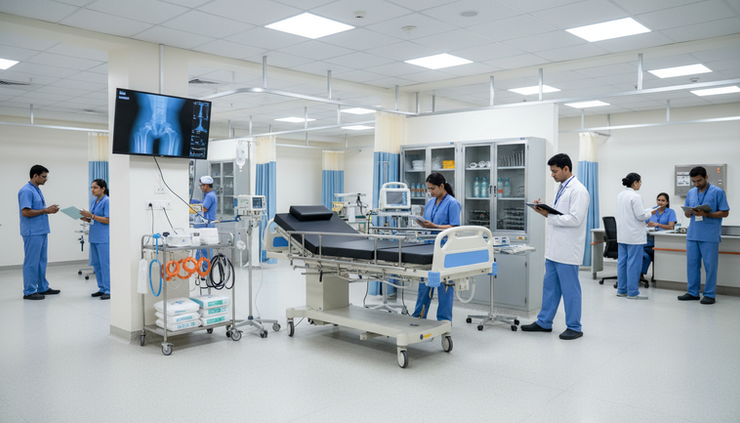
Why emergency orthopedic trauma care needs speed and structure
Orthopedic trauma refers to injuries involving bones, joints, ligaments, tendons, muscles, and nearby soft tissues. Common examples include:
Fractures after a two-wheeler accident
Wrist or ankle injuries after a fall
Shoulder or knee dislocations
Hip fractures in older adults
Crush injuries to the hand or foot
Spine injuries after a high-impact accident
Open fractures, where bone is exposed through a wound
These injuries need timely care because delay can make treatment harder. Swelling can increase, pain can become severe, and bone alignment can worsen if the injured part is moved without support. In some serious injuries, blood flow or nerve function can be affected.
Medical guidance across emergency care systems follows a simple principle: serious trauma needs early assessment, pain control, imaging, stabilisation, and treatment planning. For bone and joint injuries, that often means an orthopedic doctor should examine the patient quickly and decide whether the injury needs a cast, splint, procedure, or surgery.
For people travelling daily through Hinjewadi, Wakad, Bhumkar Wasti Road, Dange Chowk, Punawale, and Ravet, the location of care matters. A patient with a suspected fracture should not have to move from one place to another for basic imaging, then to another centre for surgery, and then to another facility for monitoring. Each transfer can add pain, delay, and risk.
Curace™ Orthopedics at Golden Care Hospital addresses this by keeping key emergency support available within the hospital setup.
Curace™ Orthopedics at Golden Care Hospital in Hinjewadi
Curace™ Orthopedics provides orthopedic trauma care at:
Golden Care Hospital
Ground Floor, Orthopedic Department
Golden Care Hospital, Bhumkar Wasti Road
Near Challenger Public School, Shedge, Wakad
Pimpri-Chinchwad, Maharashtra 411057
Emergency contact: 7757865291
The hospital location is useful for patients coming from Hinjewadi IT Park, Hinjewadi Phase 1, Phase 2, Phase 3, Wakad, Punawale, Ravet, Tathawade, and nearby areas of Pimpri-Chinchwad. For many local families and working professionals, access from the western side of Pune is an important factor during emergencies.
Dr Sunny Dole heads the orthopedic team at Curace™ Orthopedics. Patients searching for an orthopedic doctor in hinjewadi often need two things at the same time: a doctor who can assess bone and joint injuries, and a hospital setup that can support urgent care without avoidable delay.
The emergency orthopedic trauma care pathway usually includes:
Immediate clinical assessment
Pain relief and limb support
Digital X-ray when needed
CT scan when more detail is required
Plaster, splint, reduction, or surgery depending on the injury
Monitoring in the intensive care unit when the injury is serious
Follow-up treatment and rehabilitation advice
Not every fracture needs surgery. Many stable fractures heal well with a plaster, brace, or splint. But some fractures need urgent operation, especially when bones are badly displaced, a joint is involved, the skin is open, or there is concern about circulation or nerve function.
That is why emergency orthopedic care is not only about the doctor. It is also about the hospital systems around the doctor.
Facilities that matter during an orthopedic emergency
When an injury happens, the first question is often, “Is it broken?” The next question is, “How serious is it?” The answer usually depends on examination and imaging.
Curace™ Orthopedics at Golden Care Hospital has access to important in-house facilities that support emergency orthopedic decisions.
In-house CT scan for detailed injury assessment
A CT scan, also called computed tomography, gives detailed cross-sectional images of bones and joints. It is often used when a regular X-ray does not show enough detail.
A CT scan can help in cases such as:
Complex wrist fractures
Hip and pelvis injuries
Spine injuries
Joint fractures involving the knee, ankle, shoulder, or elbow
Multiple injuries after a road accident
The value of an in-house CT scan is simple. The treating team can get more information without sending the injured person to another centre. That helps reduce delay and movement, especially when the patient is in pain.
Digital X-ray for fast fracture screening
Digital X-ray is one of the first imaging tests used in suspected fractures. It helps the doctor check the position of the bone, type of break, and whether a joint is involved.
Digital X-ray is commonly used for:
Hand, wrist, and forearm injuries
Shoulder and collarbone injuries
Knee, ankle, and foot injuries
Hip pain after falls
Follow-up after plaster or surgery
A digital X-ray also helps after a fracture is aligned, because the doctor can check whether the bone position has improved.
Emergency operation theatre for urgent surgery
An operation theatre is the room where surgery is performed under sterile conditions. In orthopedic trauma, emergency surgery may be needed for serious fractures, open wounds, joint injuries, or injuries that cannot wait for a planned future date.
An emergency operation theatre can be important when:
The fracture is open and needs urgent cleaning and fixation
A joint is dislocated and cannot be safely corrected outside surgery
The bone fragments are badly displaced
There is pressure on nerves or blood vessels
Multiple injuries need coordinated surgical care
Having an emergency operation theatre available inside the hospital helps the orthopedic team move from diagnosis to treatment when surgery is needed.
ICU support for serious trauma cases
ICU stands for intensive care unit. It is used for patients who need close monitoring, support for breathing, blood pressure management, or care after major surgery.
Not every orthopedic injury needs ICU care. A simple forearm fracture does not. But serious road traffic injuries, hip fractures in older adults, spine trauma, multiple fractures, or patients with other medical conditions may need closer observation.
The availability of ICU support matters because orthopedic trauma is sometimes part of a larger emergency. The person may have blood loss, head injury, chest injury, or medical problems such as diabetes, high blood pressure, or heart disease.

When to seek emergency fracture care
Some injuries look minor at first but become painful and swollen after a few hours. Others are clearly urgent from the start. A practical rule is this: if the injured part cannot be used normally, looks deformed, has severe swelling, or causes intense pain, get medical care early.
Seek emergency orthopedic care if there is:
Severe pain after a fall, accident, or sports injury
Visible deformity in the arm, leg, wrist, ankle, or shoulder
Inability to stand, walk, lift, or move the injured part
Swelling that is increasing quickly
Numbness, tingling, or weakness after injury
Open wound near a suspected fracture
Bone visible through the skin
Pale or cold fingers or toes after injury
Back or neck pain after a high-impact accident
Hip pain after a fall in an older adult
Repeated vomiting, confusion, or loss of consciousness after trauma
If there is heavy bleeding, loss of consciousness, breathing difficulty, or suspected head, chest, or spine injury, treat it as a medical emergency. Call emergency services or reach the nearest suitable hospital without delay.
For suspected bone injuries near Hinjewadi, Curace™ Orthopedics provides emergency fracture treatment in hinjewadi with hospital-based imaging and emergency support.
What to do before reaching the hospital
The minutes after an injury matter. Simple steps can reduce pain and prevent further damage.
Keep the injured part still
Avoid moving the injured limb again and again to “check” whether it is broken. Movement can worsen pain and may shift bone fragments.
If possible, support the injured area with a pillow, folded cloth, cardboard, or a firm object. Do not tie anything too tightly.
Remove rings or tight items early
If the injury is to the hand, wrist, foot, or ankle, swelling can increase quickly. Remove rings, watches, anklets, or tight footwear if it can be done without force.
Do not pull hard if the item is stuck. Let the emergency team handle it safely.
Do not massage the injured area
Massage after an accident can worsen swelling or bleeding. It can also move the broken bone further out of position.
Avoid applying strong pressure, herbal oils, or heat to a fresh injury.
Use ice carefully
Cold packs may help reduce swelling in many soft tissue injuries. Wrap ice in a cloth and apply it for short periods. Do not place ice directly on the skin.
If the injury is open, severe, or the skin colour has changed, focus on getting medical care rather than home treatment.
Avoid food and drink if surgery may be needed
If a serious fracture may need surgery, it is safer not to eat or drink until the doctor gives advice. Anaesthesia, the medicine used to prevent pain during surgery, is safer when the stomach is empty.
Carry key information
Bring:
Any previous X-rays or reports
List of medicines
Allergy details
Details of diabetes, blood pressure, heart disease, or blood thinner use
Time and cause of injury
ID proof and insurance details, if available
These details help the care team decide faster.
What happens after you arrive at Curace™ Orthopedics
Emergency orthopedic care follows a sequence. The exact steps depend on the injury, but most patients go through a similar pathway.
The team checks pain, swelling, movement, and safety
The doctor examines the injured area and checks whether blood flow and nerve function are intact. This includes looking at skin colour, warmth, movement, and sensation in fingers or toes.
This step is important because a fracture is not only a bone problem. Nearby nerves, blood vessels, skin, muscles, and joints can also be affected.
Imaging confirms the injury
Most suspected fractures need an X-ray. Some injuries need CT scan for clearer detail. The imaging result helps the doctor decide whether the fracture is stable or unstable.
A stable fracture may be treated with plaster, splint, or brace. An unstable fracture may need alignment or surgery.
Pain relief and support are given
Pain control is part of emergency care. The injured part may be supported with a splint, plaster, sling, or traction depending on the location and severity.
Traction means gentle pulling used in selected cases to reduce pain and improve position before final treatment. If the term is unfamiliar, think of it as controlled support, not forceful pulling.
The doctor explains the treatment plan
A good emergency plan should answer simple questions:
What is injured?
Is it a fracture, dislocation, ligament injury, or soft tissue injury?
Is surgery needed?
If surgery is needed, how urgent is it?
What are the risks of waiting?
How long will recovery likely take?
What follow-up is needed?
Not all cases can be fully predicted on day one, especially with swelling or multiple injuries. Still, the patient and family should understand the immediate plan.

Common orthopedic trauma cases seen around Hinjewadi and Wakad
The Hinjewadi and Wakad belt has a mix of IT parks, residential towers, schools, highways, service roads, and active construction zones. That mix influences the types of orthopedic injuries seen in emergency departments.
Two-wheeler and road traffic injuries
Two-wheeler accidents can cause wrist, collarbone, leg, ankle, shoulder, and knee injuries. Even low-speed falls can cause fractures if the rider lands awkwardly.
Common patterns include:
Wrist fractures from landing on the hand
Collarbone fractures after impact on the shoulder
Knee and ankle injuries from twisting
Leg fractures after direct impact
Shoulder dislocations after a fall
Helmet use protects the head, but it does not prevent limb fractures. A painful swollen limb after a road accident should be examined even if the person can still move it slightly.
Falls at home or work
A slip in a bathroom, staircase fall, or fall from a small height can cause significant injury. In older adults, even a simple fall while walking can lead to hip, wrist, or spine fractures because bones may be weaker with age.
Hip fractures need early medical attention. Delay can increase complications related to pain, immobility, and other health conditions.
Sports and weekend fitness injuries
Football, cricket, badminton, cycling, gym workouts, and running are common across Hinjewadi, Wakad, Punawale, and Ravet. Sports injuries are not always fractures. They can involve ligaments, tendons, or cartilage, but severe pain and swelling after a twist or fall should be checked.
Warning signs include:
A pop sound during injury
Knee swelling within a few hours
Inability to bear weight
Shoulder slipping out of place
Repeated giving way of the knee or ankle
Hand and wrist injuries
Hand injuries need careful care because small bones, tendons, nerves, and joints sit close together. A minor-looking cut with loss of finger movement should not be ignored.
Crush injuries, deep cuts, and finger fractures may need urgent assessment to protect long-term hand function.
Why local access matters for Hinjewadi Phase 1, Phase 2, and Phase 3
Hinjewadi is spread out. Travel from Phase 3 to central Pune can take time, especially during peak traffic. A patient in severe pain should not spend extra time searching for multiple services across the city if a nearby hospital can provide assessment, imaging, and emergency orthopedic support.
Curace™ Orthopedics at Golden Care Hospital is positioned to serve patients from:
Hinjewadi Phase 1
Hinjewadi Phase 2
Hinjewadi Phase 3
Wakad
Punawale
Ravet
Tathawade
Bhumkar Wasti
Pimpri-Chinchwad
For working professionals and families in this belt, the practical benefit is shorter travel during a stressful event. This can be especially useful after late office hours, early morning travel, weekend sports injuries, or accidents on connecting roads.
The best emergency care is not only about being close. It also needs the right clinical decisions. But when the right setup is nearby, patients may reach treatment sooner and avoid unnecessary transfers.
How to decide if you need an orthopedic emergency visit or a routine appointment
Some injuries can wait for an outpatient appointment. Others should not. The difference often lies in pain severity, function, swelling, and risk.
Use this simple guide.
Situation | Suggested action |
Mild pain after exercise, no swelling, normal walking | Rest and book a routine orthopedic visit if pain persists |
Twisted ankle with swelling and difficulty walking | Get an orthopedic assessment and X-ray if needed |
Fall with visible deformity of wrist, ankle, shoulder, or leg | Seek emergency care immediately |
Road accident with limb pain, swelling, or inability to stand | Seek emergency care immediately |
Open wound near a suspected fracture | Seek emergency care immediately |
Numbness, cold fingers or toes, or weakness after injury | Seek emergency care immediately |
Hip pain after fall in an older adult | Seek emergency care urgently |
Neck or back pain after major trauma | Avoid movement and seek emergency care |
This guide is informational. A doctor’s examination is needed for diagnosis and treatment decisions.
What makes trauma care safer and clearer for families
During an emergency, families often face pressure. People gather, opinions conflict, and the patient is in pain. A structured hospital pathway helps reduce confusion.
A good orthopedic emergency team should focus on:
Stabilising the injury
Checking for danger signs
Ordering the right imaging
Explaining findings in plain language
Deciding whether surgery is needed
Monitoring serious cases
Planning follow-up after discharge
Dr Sunny Dole and the Curace™ Orthopedics team aim to provide this structured approach at Golden Care Hospital. The presence of in-house CT scan, digital X-ray, emergency operation theatre, and ICU support helps the team manage a wide range of orthopedic trauma cases under one hospital roof.
Recovery begins on the first day
Fracture treatment does not end after an X-ray, plaster, or surgery. Recovery depends on correct follow-up and safe movement at the right time.
Patients are usually advised about:
Keeping the limb elevated to reduce swelling
Watching for pain, numbness, tightness, or colour change
Keeping plaster dry
Taking medicines as prescribed
Returning for follow-up X-rays
Starting movement when the doctor allows it
Physiotherapy when needed
Physiotherapy is guided exercise and movement training. It helps restore strength, flexibility, and function after the bone or joint is stable enough.
A common mistake is returning to normal activity too early. Another is avoiding movement for too long after the doctor has permitted it. Both can delay recovery. The right plan depends on the injury, age, health conditions, and treatment type.

Emergency orthopedic contact and location
For urgent bone, joint, or fracture-related injuries near Hinjewadi, Wakad, Punawale, or Ravet, contact:
Curace™ Orthopedics at Golden Care Hospital
Emergency number: 7757865291
Address: Golden Care Hospital, Ground Floor, Orthopedic Department, Golden Care Hospital, Bhumkar Wasti Rd, near Challenger Public School, Shedge, Wakad, Pimpri-Chinchwad, Maharashtra 411057
If the injury involves heavy bleeding, loss of consciousness, breathing trouble, or suspected head, chest, or spine trauma, seek emergency medical help immediately.
For directions to the hospital, use this link: Get directions to Golden Care Hospital for emergency orthopedic care.
FAQs
Who should I call for an orthopedic emergency in Hinjewadi?
For emergency orthopedic trauma care at Curace™ Orthopedics, call 7757865291. If the patient has severe bleeding, loss of consciousness, breathing difficulty, or major trauma, treat it as a medical emergency and do not delay.
Does Curace™ Orthopedics have X-ray and CT scan facilities?
Yes. Curace™ Orthopedics at Golden Care Hospital has access to digital X-ray and in-house CT scan facilities. These help the orthopedic team assess fractures, joint injuries, and complex trauma more clearly.
Is emergency fracture surgery available at Golden Care Hospital?
Emergency orthopedic surgery support is available through the emergency operation theatre setup. Whether surgery is needed depends on the fracture type, bone position, wound condition, and the patient’s overall health.
Which areas are served by Curace™ Orthopedics in Hinjewadi?
Curace™ Orthopedics serves patients from Hinjewadi Phase 1, Phase 2, Phase 3, Wakad, Punawale, Ravet, Tathawade, Bhumkar Wasti, and nearby areas of Pimpri-Chinchwad.
Should I wait till morning if I suspect a fracture at night?
Do not wait if there is severe pain, swelling, deformity, numbness, an open wound, or inability to walk or move the injured part. Early emergency assessment can prevent avoidable complications and help control pain.
A clear local option for orthopedic trauma in Hinjewadi
Orthopedic trauma needs calm decisions and timely action. The injured person needs pain relief, safe support, proper imaging, and the right treatment plan. In serious cases, a hospital setup with emergency operation theatre and ICU support can make a real difference.
At Curace™ Orthopedics, Dr Sunny Dole heads the orthopedic emergency team at Golden Care Hospital, serving Hinjewadi, Wakad, Punawale, Ravet, and nearby areas. Save the emergency number 7757865291 now, so it is available when every minute feels important.
Comments